Thursday, May 19, 2011

The last cut is the deepest.

I did my last scarf joint the other day. I just thought I'd say.

Chris did the last let in the bows.

I planed the last plank last night.

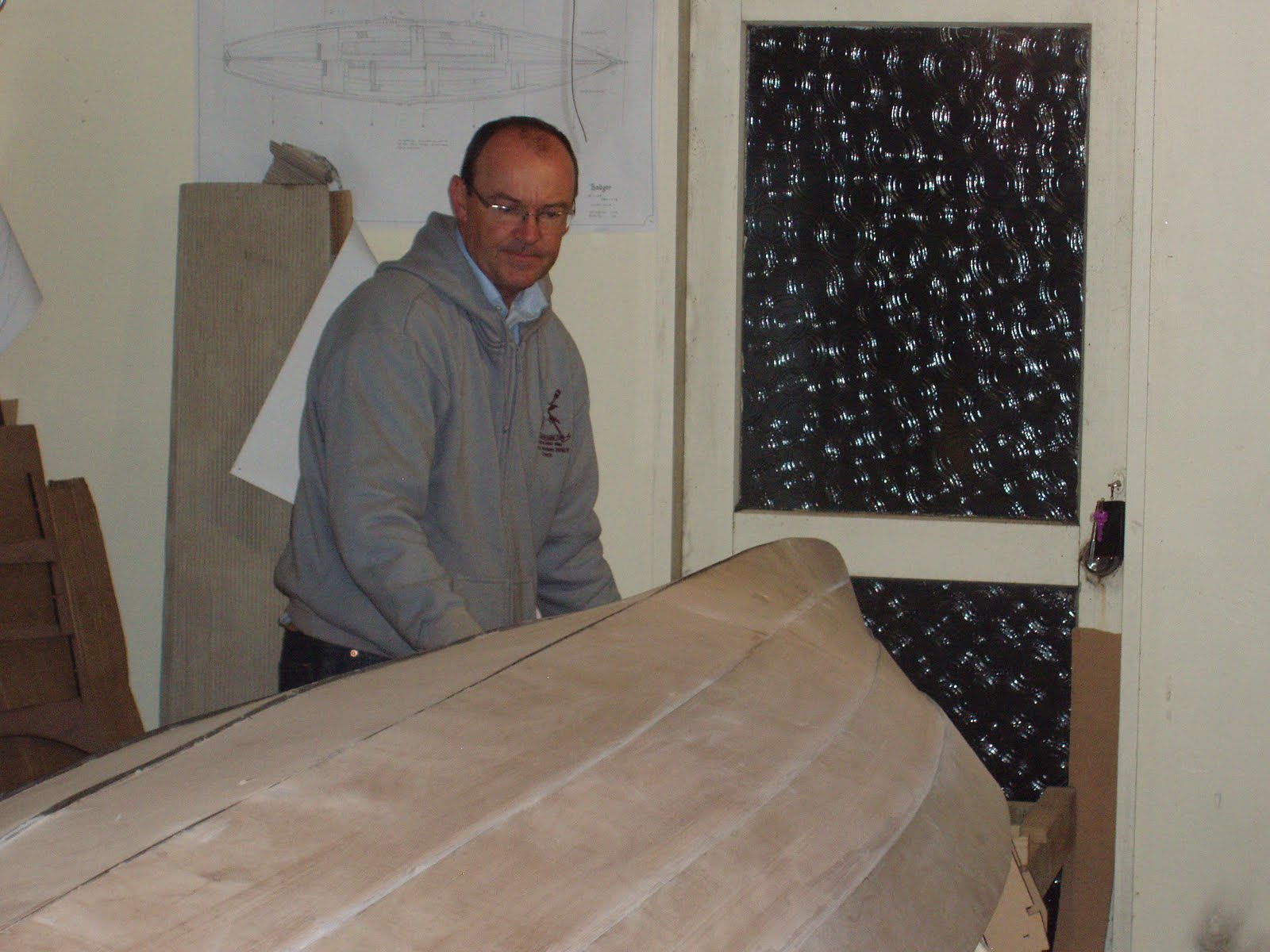
Chris was commenting, as he often does, that it's almost a shame that we've got to the last plank, because we've got into quite a rhythm in terms of scarf/glue/prepare/glue with the planks, and seem to have finally got the hang of it. He's right, it takes about 10 planks to become competent in planking. The benefit of this is that the later planks are above the waterline and therefore obviously more visible to the punters. The drawback is that our early work is below the waterline, so we'll probably sink.

Before
After.
The last scarf - Actually not one of my best, clearly familiarity does breed contempt.

Sunday, May 15, 2011

The Doldrums

 Someone asked me last night - "what happens in the doldrums?" The answer is nothing.

Nothing happens
A number of things have transpired to slow down progress on the boat.
  • I've got a huge project on at work.
  • Chris has been a bit "poorly"
  • Chris has been working in the bay of islands, when he's not been "a bit poorly"
  • My son broke his motorbike, so we've been replacing the engine.
  • Its winter, the garage is cold.
So, call this blog a stopgap, our very own boat-building doldrums.

In the meantime, let me tell you about Harry's bike, it's a tale of bad luck and worse judgement.

Harry, last in line to the O'Neill hundreds, has been pestering for a scooter, I flatly refused. They are pathetic, dangerous and require no skill or training. I wasn't having it. I said, if you get a bike, you get one with gears that keeps up with the traffic and you get some training.

Going Nowhere.
Having had his day with  Andrew Templeton, and got his license, we went on the hunt for a bike.

It transpired a guy at work was selling a GN250 - a very nice specimen too. (I think the GN stands for Go Nowhere). Here's a picture. So, I know the guy, and he gave me a very good deal, everyone was happy. Having got Harry kitted out in a load of expensive safety gear, I send him on his way.

Obviously, it all went horribly wrong, his bike broke and I had to buy a donor bike and replace the engine - to hear the full story, read the next bit. If you just want to know about the boat, and all things wood. Skip it. 

For a few weeks, all goes well, and then Harry and a mate decide to go for a proper ride. To date, Harry has been riding too and from school, a mere 2 or 3 kilometers. Barely getting the engine warm, which, as you will see, is quite a telling point.

So, Harry and "bray-bray" ask me to recommend good ride. I tell them to go up the coast to the Pauatahanui inlet (pronounced in-let) and up over Paikakariki (pronounced pie-cock) hill. Apparently the ride went so well, that they decided not to take my advice and come back down SH1, but go back the way they came. About halfway up the hill, Harry noticed a distinct lack of Braden in his mirrors, a little bit worrying if you've been over Paikak hill, there are some rather terminal drop offs. So Harry goes back in search of a break in the No 8. safety barrier. It transpires it's just a petrol issue. So Braden gets on the back of Harry's bike and they go in search of fuel. A series of envents involving a lift with a policeman, an argument with a grumpy - no, you can't put petrol in a 2 ltr coke bottle - petrol station attendant ends with them back on the hill with darkness not far away. They decide to go back the short way.

5 minutes into the journey, just enough time to get onto the busiest bit of SH1, you know, the really narrow bit at Pukerua bay, everything stops on Harry's bike and he pulls over into the gutter. Numerous attempts to restart the bike failed, and I ended up driving up on a rescue mission. I used all my mechanical skills, which involved staring at the bike and scratching my head, to no avail and we hid the bike in the bushes and came home.

The view from Paekak hill, it really is worth breaking down for.
 
 Motor-Ad picked up the bike, and discovered that there was only 130mm of oil in the bike, it had run dry, over heated, gone blue and broke. Apparently you need 1.5 ltrs of oil, something we didn't check when we bought the bike. There is a school of thought that would suggest that when you buy a bike off a guy who says - it's serviced regularly and goes like a dream, you'd think it would have some oil in it. There is another school - buyer beware.

Harry and I now know how to buy a knackered bike with a good engine, remove and replace an engine, and most importantly, how much oil you need in a GN250.  We now have -

  1. Really nice GN250 with a nice engine
  2. A knackered GN250 with a hole where the engine was.
  3. A GN250 engine with no bike, that rattles when you shake it.
And a half built boat.


Sunday, April 24, 2011

More Planks

People often say to me.. "what are you doing in my garden ???"

No, that's not it, people often say to me, "how many planks ?" It's the standard question now about the boat. The answer is 11. We have all 6 down one side and 5 down the other, which means if you look at it from the near side, it's pretty much finished.

Can you tell what it is yet ?
As you can see, the port side is fully "planked".

The transom has certainly been a work in progress, but don't worry about the glue stains, Chris can sand those out.

The photo below really gives you a sense of her shape.

As Chris said, you have to admit, it's starting to look a little bit like a boat.

Oh, and yes, plank six, is covered in clamps. Be patient. I'll take them off, sand the ends and take some more photos.
Did we mention that we made a LOT of clamps.

Monday, April 11, 2011

Division of Labour

We have just completed plank 5 (from outer space?) on the port side, and with the starboard plank to glue and then the trivial task of fitting plank six, we seem to finally have a repeatable process that has streamlined the build.

If only we'd worked it out on plank one, we'd be floating by now.

We can now fit a plank in two sessions. Unfortunately it's a chicken and egg situation so I can't describe it from start to finish - given that the last thing we do one session one, is preparation for session one of the next plank, hang on, the last thing we do on session two..

Session one, or two -
  • Scarf the planks for the next but one session
  • Glue the plank from the previous session to the boat.
  • Mark up the boat for the planing and chiseling for the next session.
  • Glue the plank from the current session for the next session.
Session two, or one -

  • Plane and chisel the boat in preparation for the next plank that we've half glued in the previous session.
  • Shape the transom for the plank for the next session.
  • Chisel the let in the fore and aft of the next plank.
  • Glue the other third of the scarf joint on the previous plank for the next session.
Luckily, Chris and I seem to have fallen into a division of these tasks so that we can work in parallel without having to supervise or hold each others (metaphorical) hands. Although we often offer each other advice or feedback, only this Sunday, Chris told me "Mmm, that was a great cup of tea".

Given that Chris lives half an hour away, I could actually do a lot of "my" jobs in his absence. Luckily we have also worked out another process.

All the other sessions -
  • I phone Chris and ask if he's coming to build.
  • He replies - "I'm on crowd control" (looking after the kids).
  • I say "That's ok, I'll glue that plank so it's ready for the next session"
  • I walk into the garage with the best will in the world, and keep walking to the TV room above the garage and watch sport on the telly. 

Workers of the World Unite.
    Coming round to build the boat tonight ?
    No, got to look after the kids...
    Oh, ok. I'll go and watch the telly.


    Seems fair.

    Thursday, March 31, 2011

    Progress Report

    Just some pictures of the boat: we are just over halfway with the planking and it's getting easier (we're getting better at it and more confident). The biggest task will be, I suspect, removing all the excess epoxy on the inside after we turn the hull over.


    (Clicking on any of our blog pictures will open a larger version)


    The bows are a thing of great beauty - we've taken great care to ensure clean, smooth lines.


    On the other hand, Joe is not, by any stretch of the imagination, a thing of beauty:


    Saturday, March 26, 2011

    Waikato? Pah!


    Jock Wishart is a friend of mine. I think he may be partly to blame for this project, along with others such as Hobbs, Colin Fellows, Malcolm Knight and Mike Hart, whose tendency to do extreme things in rowing boats has rubbed off on me in a small way. I should also apportion blame to Gill Fellows, who was my first coach in the noble art of skiffing.


    Jock has turned up in my life with a spooky consistency: I first met him back in my university days, when he inspired our crew and gave us the belief to win our little event.

    He isn’t always the best communicator: a product of his independence and focus, I suspect, but he always remembers people and kept in touch over the years. In the early 90’s, he rang me up to inform me that he had accepted the role of Head Coach for the Oxford University lightweights on condition that I join his team. For me, that was possibly the catalyst that has led to coaching, both rowing and business, becoming ‘my thing’. After turning around the fortunes of OULRC, Jock moved on to other things. A few years later, he cajoled me into rowing with him for a couple of seasons with a crew of veterans: I recall we won most of our races - it would be churlish to allow facts to interfere with that picture.


    A spinoff from all this was his invitation to me to run the team selection and development processes for some of his wacky adventures: we started by building a team to walk to the Magnetic North Pole. Here’s the thing: although Jock dreamt up some fairly wild ideas, they tended to succeed because the
    y were founded on careful preparation. Plus he was able to motivate experts in their field to contribute.


    In one 18 month period in the 90s, he rowed across the Atlantic with a tough cookie called Duncan Nicholl (I helped select Duncan, without telling Jock that the key criterion was the ability to put up with…er, Jock), led the crew which established new speed records for powered circumnavigation in a trimaran and captained the team that broke the London-Paris rowing record in the CNA Maritime Challenge. The latter brought all of these mad rowing types together, along with the great Andy Ripley, who has the distinction of being the heaviest cox I have ever had to pull along, but also the funniest.

    Along with all of this, Jock represented his country at rowing and yachting and is a veteran of the 1980 America’s Cup, as well as being a former European Dragon Boat Racing Champion. A British University championship medal winner in rowing, sprint canoeing and weight lifting, he was Project Leader of the team that broke the Round Britain powerboat record in 1989.

    A lifetime interest in polar exploration led to him becoming a member of the first team to walk unsupported to the Geomagnetic North Pole in 1992. Four years later, in organising The Ultimate Challenge, the first ever televised trek to the Magnetic North Pole – an expedition comprising largely of novice explorers.

    Now, he is off on another one: he is going to try to row to the Magnetic North Pole. This puts our trip down the Waikato into perspective!

    The expedition to the Magnetic North Pole (as certified in 1996) will set off from Resolute Bay in July/August 2011, the crew plan to row for 450 miles before finally reaching the Magnetic North Pole at 78 degrees, 35.724 minutes North, 1

    04 degrees, 11.915 minutes West.


    The Ice Boat

    For the full story, have a look at www.rowtothepole.com :


    Monday, March 21, 2011

    It's About the Boat, Lance...


    Looking back, we've spent a lot of time talking about the preparation for the bit where we actually crack on and build something recognisable as a boat. Since Christmas, we have made considerable progress, so here, for the benefit of both the readers who give a stuff about the build, as opposed to Joe's therapy-by-blog, are some roughly sequential pictures of what's gone on since January.

    You may recall that we spent a long time setting up the moulds on the strongback.


    We then attached the stem and the inner keel, or hog, then the sternpost, which would later have the transom fixed to it...


    At last, we got the first plank onto the keel. A very exciting moment, but despite appearances, we didn't have enough clamps!


    The second garboard plank fitted perfectly alongside the first. Having made this start, each subsequent plank had to be carefully shaped, or 'faired', to receive the next. The tools of choice here were the plane and, now Joe knows what one is, the spokeshave.


    Working from the bows to ensure a precise fit (the planks had useful pinholes to align with the moulds), the second plank on the Port side was shaped and fitted. Another milestone, since, in achieving this we had more or less encountered all the challenges that the planking would offer.


    From this point forward, we should merely repeat a process until the hull is complete.


    .
    .Yesterday, we fitted the third plank to the starboard side, marking the halfway point in the great planking exercise. The transom has to be shaped to receive each plank as we go along, in case there is any deviation from the plan.

    I am sure you will agree that it's beginning to look the biz....